 Deutsch
  English
 Investment Vintage-Guitars?
Introduction
 Vintage guitars are not only highly popular among musicians, but have also long become extremely attractive as an investment. When American brokerage magazines recommended investing in vintage guitars in 2005 as one of the world’s best and safest investments, prices for sought-after models increased by 50% to 100% within just two years.
The US-based Vintage Guitar Magazine publishes the Official Vintage Guitar Magazine Price Guide once a year. It is based on reported sales from approximately 25 vintage guitar dealers in the United States and serves as a recognized benchmark for nearly all guitars, basses, and amplifiers on the market from around 1900 to the present day.
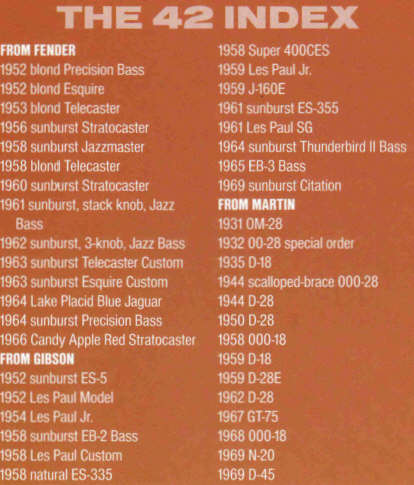
Since 1991, this price guide has also published a kind of “DAX index” for a pool of 42 common and highly sought-after guitar models made by Gibson, Fender, and Martin. Looking at this index, one can see that it pointed steadily upward until 2008, with average annual growth rates of around 10%.
After the price explosion between 2005 and 2007, the market experienced its first downward correction in 2008. This was initially due to many collectors holding on to their instruments in light of continuously rising prices, leaving the market nearly depleted and demand far exceeding supply. However, once a price peak was reached in early 2008—at a level where potential buyers showed little remaining interest—entire collections of exceptional instruments suddenly reappeared on the market.
Sellers hoped, for example, to turn ten vintage guitars (or even a single 1959 Les Paul) into the equivalent value of a family home. It soon became apparent, however, that the prices being asked—particularly in the United States—were unrealistic. As a result, prices corrected downward by approximately 10% to 20%, a trend that continued into 2009.
Since early 2010, prices stabilized again, with supply and demand relatively balanced, making instruments available once more at “reasonable” prices. Beginning in early 2013, prices in the US for sought-after models began to rise steadily again.
These sharp price increases mainly affected highly desirable instruments in the premium price segment. Guitars priced below €5,000 (for example, Fender instruments from the 1970s) were largely unaffected by either the dramatic increases or the subsequent decline in prices.
Due to the uncertainties surrounding the COVID-19 pandemic, the war in Ukraine, and rising inflation, 2021 and 2022 once again saw significant price increases for sought-after models. By then, this category also included almost all Fender and Gibson instruments from the 1970s and early 1980s, as well as older Custom Shop models. In some cases, supply had once again become very limited while demand remained high.
Meanwhile, supply and demand have largely balanced out again, and in some cases prices are already beginning to fall once more.
Vintage guitars are not only highly popular among musicians, but have also long become extremely attractive as an investment. When American brokerage magazines recommended investing in vintage guitars in 2005 as one of the world’s best and safest investments, prices for sought-after models increased by 50% to 100% within just two years.
The US-based Vintage Guitar Magazine publishes the Official Vintage Guitar Magazine Price Guide once a year. It is based on reported sales from approximately 25 vintage guitar dealers in the United States and serves as a recognized benchmark for nearly all guitars, basses, and amplifiers on the market from around 1900 to the present day.
Since 1991, this price guide has also published a kind of “DAX index” for a pool of 42 common and highly sought-after guitar models made by Gibson, Fender, and Martin. Looking at this index, one can see that it pointed steadily upward until 2008, with average annual growth rates of around 10%.
After the price explosion between 2005 and 2007, the market experienced its first downward correction in 2008. This was initially due to many collectors holding on to their instruments in light of continuously rising prices, leaving the market nearly depleted and demand far exceeding supply. However, once a price peak was reached in early 2008—at a level where potential buyers showed little remaining interest—entire collections of exceptional instruments suddenly reappeared on the market.
Sellers hoped, for example, to turn ten vintage guitars (or even a single 1959 Les Paul) into the equivalent value of a family home. It soon became apparent, however, that the prices being asked—particularly in the United States—were unrealistic. As a result, prices corrected downward by approximately 10% to 20%, a trend that continued into 2009.
Since early 2010, prices stabilized again, with supply and demand relatively balanced, making instruments available once more at “reasonable” prices. Beginning in early 2013, prices in the US for sought-after models began to rise steadily again.
These sharp price increases mainly affected highly desirable instruments in the premium price segment. Guitars priced below €5,000 (for example, Fender instruments from the 1970s) were largely unaffected by either the dramatic increases or the subsequent decline in prices.
Due to the uncertainties surrounding the COVID-19 pandemic, the war in Ukraine, and rising inflation, 2021 and 2022 once again saw significant price increases for sought-after models. By then, this category also included almost all Fender and Gibson instruments from the 1970s and early 1980s, as well as older Custom Shop models. In some cases, supply had once again become very limited while demand remained high.
Meanwhile, supply and demand have largely balanced out again, and in some cases prices are already beginning to fall once more.
Which guitars should I invest in?
Fortunate are those who purchased their instruments ten or more years ago. They can rest easy, cushioned by a healthy margin of appreciation, and need not fear ever having to sell their investment for less than their initial purchase price. Anyone looking to enter the vintage market today should heed a few key rules—insights we are happy to share with all newcomers to the world of vintage guitars, drawn from our own experience of over 40 years in the business:
1. Not every old guitar is a collectible vintage instrument with strong potential for appreciation. A guitar is not necessarily valuable simply because it is old or rare. The instrument's popularity is of paramount importance. Typically, this popularity stems from the fact that the instrument has been widely adopted by musicians—foremost among them the Fender Stratocaster, Telecaster, and Gibson Les Paul from the 1950s and 60s. For instance, although tens of thousands of Fender Stratocasters were manufactured in the 1960s, it remains such a popular and highly sought-after guitar that instruments in pristine condition dating from before 1971 are now rarely available for under €10,000. The 1959 Gibson Les Paul, of which only about 1,200 units were produced, currently fetches between €300,000 and €600,000 in original condition. Other instruments—such as those by Rickenbacker—were produced in the 1960s in only double-digit quantities; however, as they were (and remain) played by only a select few musicians, they can be acquired today at 'bargain prices' ranging from €3,000 to €6,000. Instruments from most German manufacturers are even less popular. In the 1950s and 60s, a Framus guitar was already considered a second-choice option for those who could not afford an American instrument; consequently—with very few exceptions—such guitars today command a price that barely exceeds their original retail value, adjusted for inflation.
2. It is better to buy a few 100% original instruments than a motley assortment or guitars that have been heavily modified. For instance, if one assumes a price of 12,000 euros for a 1968 Stratocaster in the standard Sunburst finish and in good overall condition, that price could quickly double or triple for a superbly preserved instrument in a rare color with documented provenance; conversely, it could just as quickly be cut in half due to a routing modification hidden beneath the pickguard—invisible from the outside—or perhaps a few replaced parts. Consequently, the instruments that best retain their value—and offer the highest potential for appreciation—are highly sought-after models in absolutely 100% original condition, a status that includes the original case. Even a single wire that has been desoldered and resoldered can reduce the value by hundreds of euros, as it raises questions regarding the 'why' and casts doubt upon the instrument's originality. Any irreversible modifications—such as refinishes, oversprays, touch-ups, routing, drilled holes, etc.—result in a significant depreciation in value. Modifications involving smaller deductions—and thus still considered acceptable—include refretting or the replacement of a defective nut, provided that these tasks were executed professionally and using materials consistent with the originals. The replacement of other components—such as potentiometers, switches, or pickups—initially results in a baseline depreciation of approximately 10–20%, simply because the instrument is no longer entirely original; furthermore, the replacement cost of the specific part in question—which for a vintage pickup, for example, can range anywhere from 500 to 1,500 euros—is deducted from the value.
3. Buy from trustworthy sources. By now, there are likely thousands of counterfeits—or so-called 'originals' cobbled together from various parts—circulating on the market. When prices soar well beyond the 10,000-euro mark, it becomes financially worthwhile for counterfeiters to spend weeks or even months working on a single instrument, incorporating a few genuine vintage parts to pass it off as an authentic original. There have been numerous lawsuits involving allegedly counterfeit or refinished vintage instruments; in these cases, courts and expert appraisers have often found themselves overwhelmed, as an 'ordinary' person can hardly grasp why a guitar gleaming with a fresh coat of lacquer should be considered far less valuable than one with completely worn-down original finish. Moreover—particularly for Fender and Gibson guitars—almost every hardware component is now available as an artificially aged replica; some even bear original-style serial numbers and can only be distinguished from the genuine article by an expert using a magnifying glass and drawing upon extensive experience. Skepticism is always warranted if a guitar's provenance cannot be traced back at least ten years—ideally twenty to thirty years, and in the best-case scenario, all the way back to the date of its original purchase. The community of vintage instrument dealers in Europe and the USA is relatively small; consequently, if an instrument has been inspected by one or more reputable dealers—and its history can be clearly traced—so much the better. However, if an instrument suddenly appears out of nowhere (as a so-called 'attic find'), the utmost caution is advised. Such instruments are frequently offered for sale on eBay, where the seller deliberately remains tight-lipped and provides scant details regarding the instrument's originality.
4. Whenever possible, purchase your instrument from within the EU. Under the latest EU legislation, a retailer based within the EU is required to grant a right of return and a warranty for purchases made via mail order. Furthermore, in the event of a valid complaint, the buyer has grounds to claim compensation. When purchasing from outside the EU, there is generally no right to a return, warranty, or compensation; moreover, in the vast majority of cases involving shipping damage, the buyer will not receive compensation unless the package was properly insured, shows visible external damage, and receipt has not yet been acknowledged. While prices in the USA may appear cheaper at first glance—due to a wider selection and a favorable Euro-to-Dollar exchange rate—one must bear in mind that importing an item into Germany entails significant additional costs: in addition to substantial shipping fees, approximately 5% in customs duties and 19% in import VAT apply, and the buyer also accepts the aforementioned disadvantages. Anyone personally bringing an old instrument back from outside the EU should, without fail, carry a proper, stamped invoice and voluntarily declare the instrument to customs officials. In recent years, customs officers at almost all major airports have received specialized training regarding vintage instruments; anyone attempting to smuggle an instrument through the 'green channel' risks being stopped and subsequently required to pay not only the applicable duties and taxes but also a hefty fine. Conversely, anyone wishing to take an instrument abroad—with the intention of bringing it back later—should have the export officially certified by German customs, including detailed specifications; otherwise, upon their return, they may face a situation where they are required to pay customs duties and taxes on their own instrument all over again. Very Important: Instruments containing components (e.g., fingerboards, bodies, or bridges) made of the precious wood Rio Rosewood (or 'Brazilian Rosewood') may be imported for private use only if accompanied by a CITES import permit from the EU country of entry and a CITES export document from the country of origin. This implies that, even with these permits, such instruments may neither be resold nor used for professional purposes. This category includes, for example, many Gibson and Fender instruments manufactured prior to 1966. Since 1992, the importation of such instruments without the necessary permits—even if customs formalities are otherwise properly completed—has been classified as a criminal offense; in addition to substantial fines, this may result in the confiscation of the instrument. Further information on this subject is available on the website of the Federal Agency for Nature Conservation (a fact sheet regarding Rio Rosewood, along with additional details, can be found at: http://www.Rio-Palisander.de).
Summary
Genuine vintage instruments represent one of the safest and most stable investments—offering significant potential for appreciation—that also allow you to make music. The downside: they are bulkier than stocks or cash. You won't find any old Strats for sale at Thomann. Therefore, prospective buyers should turn to a trusted vintage dealer or collector—unless they happen to be experts themselves. To avoid disputes regarding authenticity and condition, be sure to obtain written confirmation for both, and—whenever possible—make your purchase within the EU. For those looking to enter the world of vintage instruments, there is a wealth of literature available—most notably the *Official Vintage Guitar Magazine Price Guide*—as well as this phone number: 0441-3800334 (Jörn Eisenhauer).
 Seite drucken
 Email
Email© 2026 by vintage-guitar.de | invest-vintage.html | Impress | Terms / Conditions | Data Protection | 0.0269 Sek